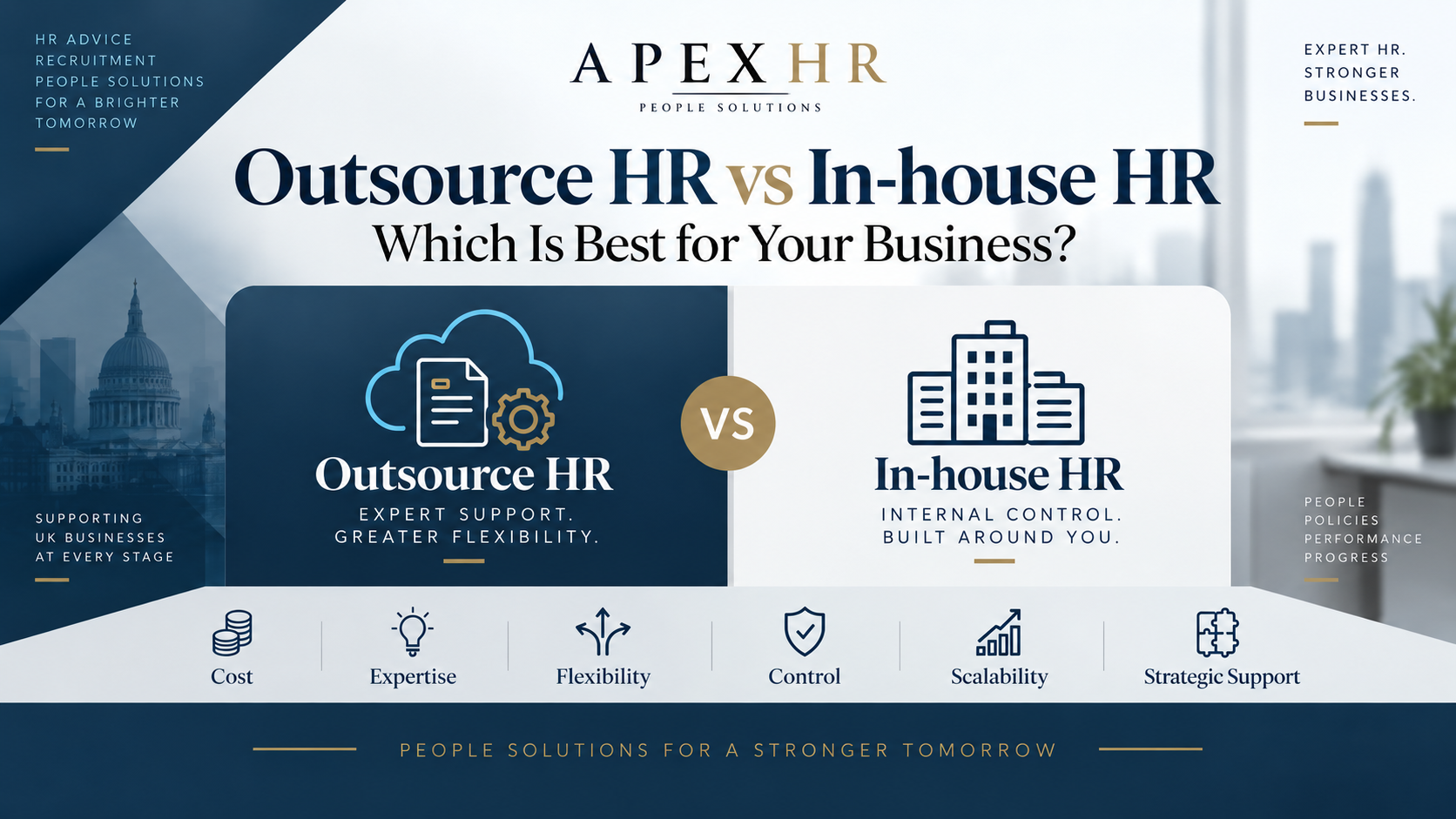
Deciding between Outsource HR vs In-house HR is an important consideration for businesses that want to build a strong workforce without creating unnecessary costs or administrative complexity. While an in-house HR team gives a business dedicated internal expertise, outsourced HR provides access to experienced professionals without requiring the organisation to employ an entire HR department.
However, the decision is rarely as simple as choosing between internal and external HR. The right approach depends on the size of the organisation, workforce requirements, growth plans, internal expertise and strategic objectives.
For a small or growing company, outsourced HR can provide access to experienced HR professionals, employment guidance, recruitment support and people strategy without the cost of building a full department. Conversely, larger organisations with complex workforce structures may benefit from having dedicated HR professionals embedded within the business.
This guide examines Outsource HR vs In-house HR across cost, expertise, flexibility, control, scalability and strategic capability. More importantly, it explains how businesses can determine which model—or combination of models—best supports their people and commercial objectives.
Phone: +447762272692
Email: info@apexhrllc.com
Address: London, United Kingdom
Website: Apex HR
Outsource HR vs In-house HR: What Is the Difference?
The fundamental difference between outsourced and in-house HR is where responsibility for HR activities sits.
An in-house HR team consists of employees who work directly for the organisation. They may manage recruitment, employee relations, performance management, HR policies, compliance, learning and development, compensation and workforce planning.
Outsourced HR, on the other hand, involves engaging an external HR specialist or consultancy to provide some or all of these services.
The scope can vary considerably. A company might outsource only employment-law support or recruitment, for example, while another organisation may use an external provider as its complete HR function.
Therefore, when considering Outsource HR vs In-house HR, businesses should focus less on which model is theoretically better and more on which approach provides the right capabilities for their specific requirements.
The Difference Between Outsourced HR and an In-house HR Team
| Area | Outsourced HR | In-house HR |
| Employment | External HR professionals | Directly employed HR professionals |
| Cost model | Service fees or retainers | Salaries and employment overheads |
| Expertise | Access to multiple specialists | Depends on internal team |
| Organisational knowledge | Developed through the relationship | Built directly within the business |
| Flexibility | Services can often be scaled | Capacity depends on headcount |
| Strategic support | Can provide external senior expertise | Integrated directly into business planning |
| Technology | May be included within the service | Organisation funds its own systems |
| Control | Governed by service agreement | Direct management control |
| Scalability | Additional support can often be added quickly | Requires recruitment as demand increases |
| Ideal for | SMEs, growing businesses and organisations needing specialist expertise | Larger organisations with substantial ongoing HR needs |
Neither model is automatically better. Instead, the most appropriate solution depends on the organisation’s workforce, resources and objectives.
Outsourced HR vs In-house HR Comparison
When comparing Outsource HR vs In-house HR, businesses should consider more than the immediate financial cost.
Outsourced HR can provide specialist expertise, flexibility and access to a broader team. Meanwhile, an internal HR department can provide deeper organisational knowledge, direct access and greater control over day-to-day priorities.
For example, a growing business may need support with recruitment, organisational development and workforce planning but may not yet have enough HR activity to justify multiple permanent specialists.
In contrast, a large organisation may have enough employees and HR activity to support dedicated HR business partners, recruiters, employee-relations specialists and learning professionals.
Consequently, the right HR structure should evolve with the organisation.
Outsourced HR vs In-house HR: Key Differences
Cost: Outsourcing can reduce the need for permanent HR headcount, although service fees can increase as requirements become more complex. An internal team creates salaries, benefits, recruitment, training and technology costs.
Expertise: External HR partners can provide access to different specialists. An internal team may have deeper knowledge of the organisation but fewer specialist resources.
Control: An internal department gives management direct control over HR priorities. Outsourced HR operates according to agreed responsibilities and service levels.
Flexibility: External support can often be adjusted according to business requirements. Internal capacity generally changes when employees are recruited, redeployed or leave.
Strategy: Both models can contribute to people strategy. However, external senior HR specialists can provide strategic expertise without requiring a permanent senior appointment.
What Is Outsourced HR?
Outsourced HR involves using an external HR provider to manage specific HR responsibilities or an organisation’s broader people function.
Rather than hiring multiple specialists internally, a business can access external expertise according to its requirements.
Outsourced HR services can include:
- Talent acquisition and recruitment
- Employment contracts and HR policies
- Employee relations
- Performance management
- Compensation and benefits
- Learning and development
- Organisational development
- Employee experience
- HR technology
- People analytics
- Workforce planning
- HR compliance
- Strategic HR consultancy
- Fractional HR leadership
This makes outsourcing particularly valuable when an organisation requires capabilities that are difficult or expensive to build internally.
Benefits of Outsourcing HR
One of the biggest advantages of outsourced HR is access to professional expertise without having to establish a large permanent HR department.
Furthermore, businesses can obtain support across multiple areas of people management.
For example, an organisation experiencing rapid growth may need to recruit new employees while simultaneously reviewing its organisational structure, performance processes and workforce capabilities.
An external HR partner can support several of these requirements within one engagement.
Other potential benefits include:
- Access to experienced HR professionals
- Flexible support
- Specialist expertise
- Reduced internal HR administration
- Additional capacity during periods of growth
- Support with complex employee matters
- Access to HR technology and analytics
- Strategic people advice
- Workforce planning expertise
However, businesses should assess the specific service model carefully. Not every outsourced HR provider delivers the same depth of strategic or operational support.
Disadvantages of Outsourcing HR
Outsourcing HR can also introduce challenges.
An external provider does not automatically possess the same understanding of an organisation’s culture and employees as someone working inside the business every day.
In addition, the quality of the relationship can depend on adviser continuity, communication and the scope of the agreement.
Potential disadvantages include:
- Less direct control
- Reliance on an external provider
- Potential communication delays
- Recurring service costs
- Additional charges for specialist projects
- External management of confidential employee information
- Possible changes in assigned consultants
Therefore, organisations should establish clear responsibilities, service levels, data protection arrangements and escalation procedures before outsourcing HR.
How Apex HR Can Support Your Business
If your organisation needs professional HR expertise without immediately building a large internal department, Apex HR provides a broader people-focused approach to outsourced HR.
Apex HR’s services span talent acquisition, executive search, organisational development, learning and development, performance and talent management, compensation and benefits, employee experience, HR technology, people analytics and workforce planning.
This means businesses can address immediate HR requirements while also developing the people capabilities needed for sustainable growth.
What Is In-house HR?
In-house HR refers to HR professionals employed directly by an organisation.
The structure can range from a single HR manager to a large department containing HR business partners, recruitment specialists, employee-relations professionals, learning and development specialists and senior HR leadership.
Because these professionals work directly within the organisation, they can develop a detailed understanding of its people, culture and operating environment.
Benefits of In-house HR
The main advantage of an internal HR team is proximity to the business.
HR professionals can build long-term relationships with managers and employees. Consequently, they may have a deeper understanding of workplace culture, leadership expectations and employee concerns.
Other advantages include:
- Direct access to HR professionals
- Greater control over HR priorities
- Strong organisational knowledge
- Consistent internal processes
- Close relationships with employees
- Direct involvement in business planning
- Greater ownership of HR data and systems
- Ability to develop organisation-specific processes
Furthermore, an internal HR team can become deeply embedded in long-term workforce planning and organisational development.
Disadvantages of In-house HR
However, an internal HR function can become expensive, particularly when a business requires several specialists.
The total cost includes more than salaries. Employers may also need to cover recruitment, employer contributions, benefits, professional development, HR technology and other employment costs.
Smaller teams can also create capability gaps.
For example, one HR manager may be responsible for recruitment, employee relations, compliance, performance management and strategic planning. When a highly specialised issue arises, the organisation may still need external HR consultancy.
Therefore, having an internal HR function does not necessarily eliminate the need for external expertise.
Outsource HR vs In-house HR: Which Model Offers More Value?
The answer depends on what the business needs HR to accomplish.
If the primary requirement is day-to-day employee administration, an internal HR manager may provide sufficient capacity. Alternatively, a small company may find it more efficient to outsource these responsibilities.
However, the comparison becomes more complex when strategic HR enters the equation.
Businesses going through expansion, restructuring, international growth or organisational transformation may require expertise in areas such as:
- Organisational design
- Workforce planning
- Leadership development
- Talent management
- Performance management
- Compensation strategy
- Employee experience
- People analytics
In these situations, the value of an HR partner should be measured by its ability to connect people decisions with business objectives.
Strategic HR Can Change the Calculation
Apex HR’s approach is designed around this connection.
Rather than viewing HR as purely administrative, Apex HR positions people strategy alongside broader business priorities. Its services span the employee lifecycle, allowing organisations to connect recruitment, development, performance, reward and workforce planning.
Therefore, businesses considering Outsource HR vs In-house HR should ask an additional question:
What does the organisation need its HR function to achieve over the next three to five years?
The answer may determine whether the business needs administration, strategic HR leadership or a combination of both.
How Much Does Outsourced vs In-house HR Cost?
There is no universal price for either model.
Outsourced HR may be charged through monthly retainers, employee-based pricing, hourly rates or project fees.
In-house HR costs generally include salaries, benefits, employer contributions, recruitment, training, software and other employment overheads.
Therefore, comparing a provider’s monthly fee with an HR employee’s salary alone does not provide a complete picture.
What Determines Outsourced HR Costs?
Outsourcing costs can depend on:
- Number of employees
- Services required
- Adviser access
- Case volume
- Locations
- HR technology
- Recruitment requirements
- Payroll requirements
- Strategic consultancy
- Project work
- On-site support
Employers should request an itemised proposal and establish what happens when requirements change.
What Determines In-house HR Costs?
Internal HR costs may include:
- HR salaries
- Employer National Insurance contributions
- Pension contributions
- Benefits
- Recruitment
- Training
- Professional memberships
- HR software
- Office resources
- Specialist consultancy
- Management time
As the organisation grows, it may also need additional HR specialists.
Consequently, the true cost of an internal HR function can be significantly higher than the salary of its first HR employee.
When Should You Outsource HR?
Outsourcing HR can be particularly useful when an organisation needs professional HR support but does not have sufficient scale or resources to build a complete internal function.
Businesses may consider outsourcing when:
- HR responsibilities are consuming management time
- The organisation is growing quickly
- HR expertise is limited internally
- Employment issues are becoming more complex
- The business needs strategic HR leadership
- Recruitment requirements are increasing
- Workforce planning needs improvement
- The organisation needs specialist expertise
- A temporary HR capability gap exists
- The business wants to introduce HR technology or analytics
For example, a growing company may not need a full-time compensation specialist, organisational development specialist and senior HR leader. Through outsourcing or fractional HR, it can access these capabilities when required.
When Should You Build an In-house HR Team?
An internal HR department can become more valuable as the organisation’s workforce and HR activity increase.
An in-house model may make sense when:
- The business has a large workforce
- HR activity is continuous and substantial
- Managers need daily HR support
- Employee relations cases are frequent
- The organisation has complex internal structures
- HR needs to be deeply embedded in business operations
- The organisation wants dedicated HR leadership
- There is sufficient budget for an internal team
However, even large organisations may outsource specialist functions.
For instance, an internal HR department might manage everyday employee relations while using an external partner for organisational transformation, executive search, compensation benchmarking or workforce planning.
Is a Hybrid HR Model the Better Option?
For many organisations, the choice does not have to be entirely outsourced or entirely internal.
A hybrid HR model combines an internal HR capability with external specialists.
For example, an organisation might employ an HR manager who handles everyday employee matters while an external partner supports:
- Strategic HR
- Workforce planning
- Organisational development
- Executive recruitment
- Compensation and benefits
- People analytics
- HR technology
- Complex HR projects
This can provide the organisation with internal ownership while still giving it access to specialist expertise.
Why Businesses Use Hybrid HR
A hybrid approach can be particularly useful during periods of change.
A company may have sufficient internal HR resources for normal operations but require additional expertise during rapid expansion, restructuring or an acquisition.
Instead of permanently increasing headcount, the business can bring in external expertise when required.
For growing organisations, this can provide a balance between control, flexibility and specialist capability.
How to Choose the Right HR Model for Your Business
The best approach to Outsource HR vs In-house HR is to evaluate the organisation’s current and future requirements.
Assess Your Workforce
Start with workforce size, locations, employee demographics and expected growth.
A business with twenty employees will generally have different HR requirements from a business with 500 employees.
Review Your Current HR Capability
Identify what your current HR team can handle and where capability gaps exist.
Do you need more administrative capacity, employment expertise or strategic HR leadership?
Calculate the Full Cost
Compare the complete cost of an internal team with the total cost of outsourced HR services.
Include salaries, benefits, technology, recruitment, training and specialist support when calculating the internal option.
Consider Strategic Priorities
Determine whether your business is focused on:
- Growth
- Recruitment
- Retention
- Organisational change
- Leadership development
- Workforce planning
- International expansion
- Employee experience
Your HR model should support these priorities rather than simply manage administrative tasks.
Consider Apex HR as a Strategic People Partner
For businesses that require more than basic HR administration, Apex HR can provide access to a broad range of people capabilities.
Its services span talent acquisition, executive search, organisational development, learning and development, performance and talent management, compensation and benefits, employee experience, HR technology, people analytics and workforce planning.
This breadth can help businesses build a connected people strategy rather than addressing HR challenges in isolation.
Questions to Ask Before Choosing Your HR Model
Before deciding between outsourced and in-house HR, ask:
- What HR activities do we need support with?
- How many employees do we currently have?
- How quickly is our workforce expected to grow?
- What HR expertise do we already have?
- How much time are managers spending on HR?
- Do we require specialist employment expertise?
- Do we need strategic HR leadership?
- What is our total HR budget?
- What HR technology do we currently use?
- Would a fractional HR model work for us?
- Would a hybrid approach provide better value?
- How will our HR requirements change as the business grows?
The answers can provide a clearer basis for choosing the appropriate HR structure.
FAQs About Outsource HR vs In-house HR
1. What Is the Difference Between Outsourced HR and In-house HR?
Outsourced HR is provided by an external HR specialist or consultancy, whereas in-house HR is managed by employees directly employed by the organisation. Both can support recruitment, employee relations, compliance and people strategy.
2. Is Outsourcing HR Cheaper Than Hiring an HR Manager?
It can be, particularly when a business needs professional HR support but does not require a full-time HR department. However, costs depend on the scope of services and the organisation’s workforce requirements.
3. What Are the Main Advantages of In-house HR?
The main advantages include direct control, close employee relationships and strong knowledge of the organisation’s culture, structure and people.
4. What Are the Benefits of Outsourcing HR?
Outsourcing can provide access to experienced specialists, flexible support, strategic expertise and additional HR capacity without requiring the business to employ a large permanent HR team.
5. What Are the Disadvantages of Outsourcing HR?
Potential disadvantages include reduced direct control, reliance on an external provider, communication challenges and recurring service fees. Businesses should carefully review service levels and contract terms.
6. Can Small Businesses Outsource Their HR?
Yes. Small businesses can outsource some or all HR activities, including policies, employee relations, recruitment, compliance and strategic HR support.
7. When Should a Business Hire an In-house HR Team?
An internal HR team may make sense when the organisation has substantial and ongoing HR requirements, needs daily HR support or wants HR professionals deeply embedded in its operations.
8. Is a Hybrid HR Model Better Than Fully Outsourced or In-house HR?
For some organisations, yes. A hybrid model combines internal HR ownership with external specialist expertise, allowing businesses to access additional capabilities when required.
9. How Do I Choose Between Outsource HR vs In-house HR?
Compare both models based on cost, expertise, control, flexibility, scalability, technology, workforce size and strategic objectives. Also consider whether a hybrid model would better suit the organisation.
Build a Stronger People Strategy with Apex HR
The decision between Outsource HR vs In-house HR should ultimately be based on what your organisation needs its people function to achieve.
An in-house HR team can provide continuity, direct access and deep organisational knowledge. Outsourced HR, meanwhile, can provide flexibility and access to a wider range of specialist expertise. For many growing businesses, combining the two approaches can provide the strongest balance.
Apex HR takes a people-first, commercially focused approach to HR. Its services cover the employee lifecycle, including talent acquisition, executive search, organisational development, learning and development, performance and talent management, compensation and benefits, employee experience, HR technology, people analytics and workforce planning.
Rather than treating HR as a collection of disconnected activities, Apex HR helps organisations connect people strategy with business objectives.
Whether you need additional HR capacity, strategic people expertise, workforce planning or support building a more effective HR function, Apex HR can help you determine the right approach.
If you are evaluating Outsource HR vs In-house HR, speak with Apex HR about your organisation’s workforce, current HR capabilities and future business objectives. Together, we can develop a practical people strategy that supports growth, strengthens your workforce and delivers measurable business value.
Leave a Reply